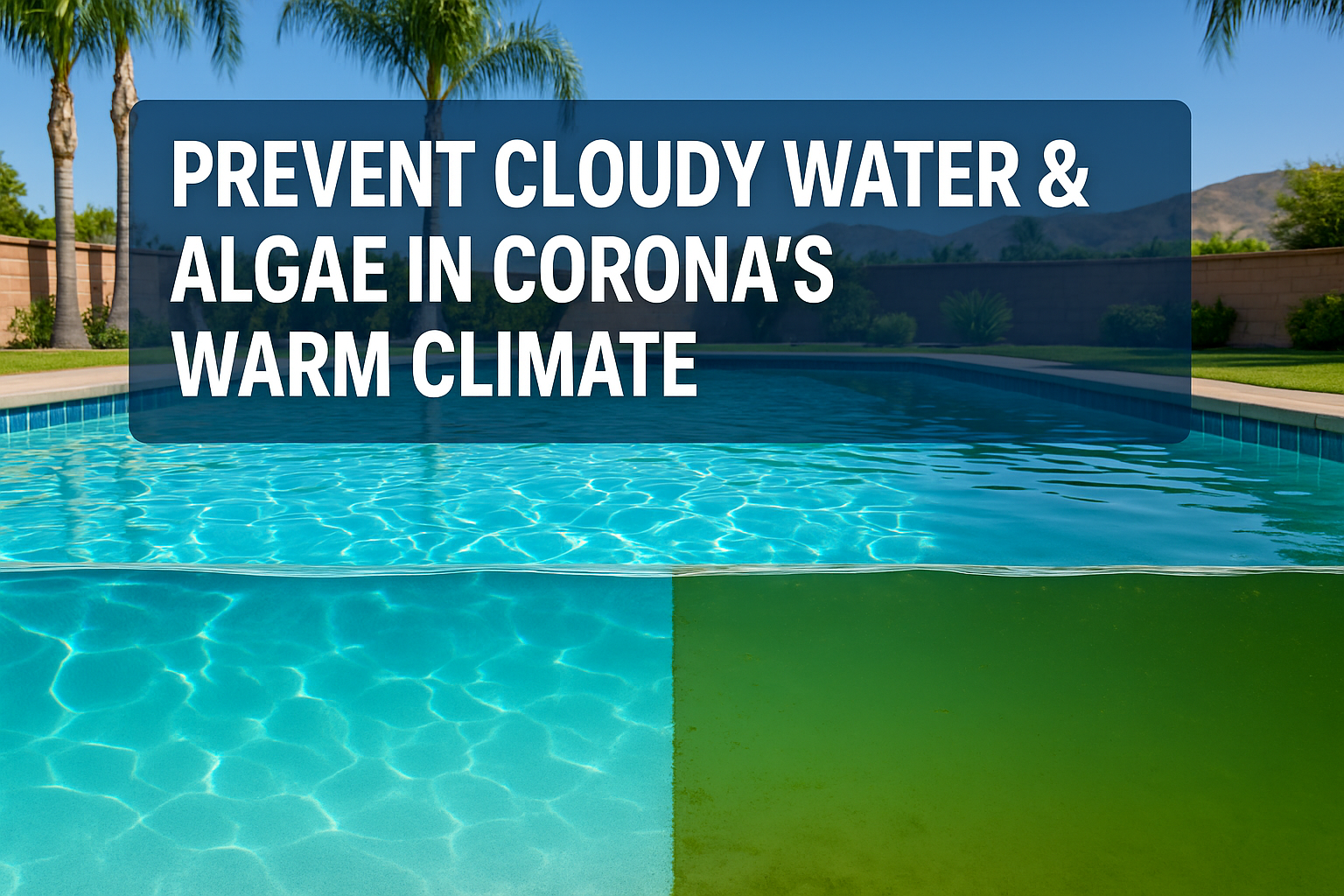
Picture this: It’s a scorching Saturday afternoon in Corona, and you’re ready to dive into your backyard oasis. But instead of inviting crystal-clear water, you’re staring at a murky, green-tinged pool that looks more like a swamp than a swimming spot. If you’ve experienced this frustrating scenario, you’re not alone. Cloudy Water & Algae in Corona are among the most common complaints I hear from local pool owners, and the region’s unique warm climate creates the perfect conditions for these problems to flourish.
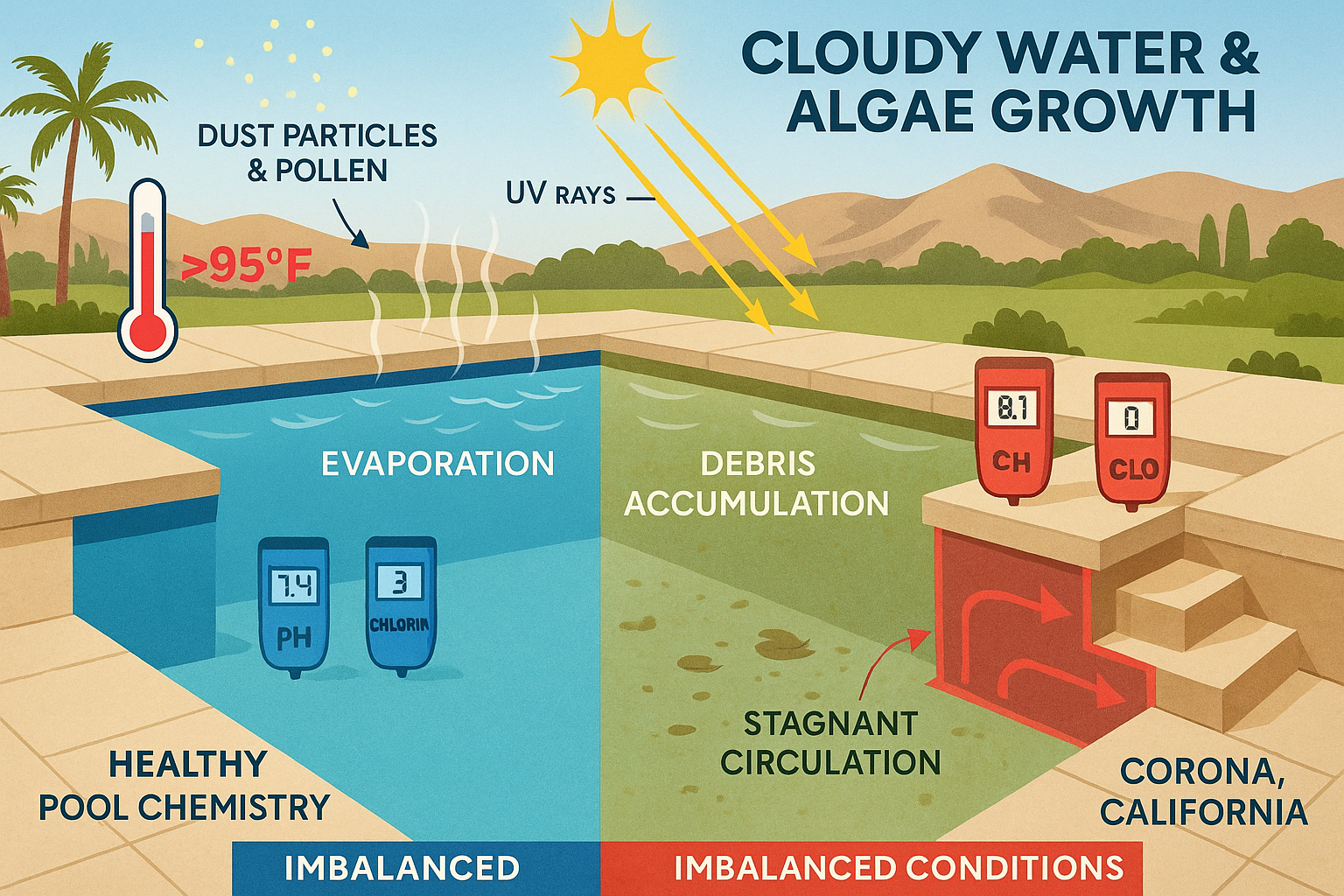
Corona’s hot, dry summers—with temperatures regularly soaring above 95°F—combined with intense UV exposure, dust storms, and rapid evaporation, create a challenging environment for maintaining pristine pool water. The good news? With the right knowledge and consistent maintenance routine, you can keep your pool sparkling clear all year long, even during the most intense heat waves.
Key Takeaways
Test your water chemistry at least twice weekly during Corona’s warm months to maintain proper chlorine (2.0-4.0 ppm) and pH (7.2-7.6) levels that prevent algae growth
Daily brushing of pool surfaces is essential in warm climates to prevent algae from establishing colonies in low-circulation areas like steps and corners
Corona’s high temperatures accelerate chemical consumption and evaporation, requiring more frequent monitoring and adjustments than cooler regions
Preventative algaecide treatments during summer months significantly reduce the likelihood of algae blooms that cause cloudy water
Proper circulation and filtration are your first line of defense—never turn off your pump during heat waves, even to save on electricity
Why Pools in Corona Are Prone to Algae & Cloudy Water
Understanding why Cloudy Water & Algae in Corona are such persistent problems starts with recognizing our unique environmental challenges. Corona sits in the Inland Empire region of Southern California, where summer temperatures frequently exceed 100°F and the intense sun beats down relentlessly on exposed pool surfaces.
High Temperatures Accelerate Algae Growth
Warm water is like a five-star resort for algae. When pool temperatures climb above 85°F—which happens regularly in Corona from May through October—algae reproduction rates skyrocket[1]. Each 10-degree increase in water temperature can double the growth rate of certain algae species, turning a small problem into a full-blown green pool in just 24-48 hours.
Evaporation Creates Chemical Imbalances
Corona’s low humidity and high temperatures cause pools to lose 1-2 inches of water per week during peak summer months[2]. While water evaporates, chemicals don’t—they become more concentrated. This disrupts your carefully balanced chemistry, leading to pH spikes, increased calcium hardness, and other imbalances that cloud your water.
Organic Matter Buildup
Our region experiences frequent Santa Ana winds that blow dust, pollen, leaves, and debris directly into pools. Add sunscreen, body oils, and other contaminants from swimmers, and you’ve got a nutrient-rich environment where algae and bacteria thrive. This organic matter also overwhelms your filtration system, contributing to cloudy water conditions.
The Perfect Storm: Warm Water + Poor Circulation
When these factors combine—especially if your pump isn’t running long enough or your filter is clogged—you create stagnant pockets of warm water where algae colonies establish themselves. These dead zones, typically found in corners, on steps, and around pool fixtures, become algae breeding grounds that quickly spread throughout your entire pool.
Top 5 Causes of Cloudy Pool Water in Southern California
Let me walk you through the most common culprits I encounter when diagnosing Cloudy Water & Algae in Corona pools:
1. Imbalanced Chlorine or pH Levels
Chlorine is your primary defense against both cloudy water and algae. When chlorine levels drop below 2.0 ppm—which happens quickly in Corona’s intense sun—algae and bacteria multiply rapidly[3]. Similarly, when pH drifts above 7.6, chlorine effectiveness plummets by up to 50%, even if you have adequate chlorine levels.
Chemical Parameter
Ideal Range
Corona Climate Impact
Free Chlorine
2.0-4.0 ppm
Depletes 2-3x faster in heat
pH
7.2-7.4
Rises quickly due to evaporation
Cyanuric Acid
30-50 ppm
Essential for UV protection
Total Alkalinity
80-120 ppm
Stabilizes pH levels
2. Poor Filtration or Clogged Filters
Your filter is the workhorse that removes microscopic particles causing cloudiness. When filters become clogged with debris, oils, and minerals from Corona’s hard water, they can’t effectively clean your pool. I recommend checking your filter pressure weekly—when it rises 8-10 PSI above the clean baseline, it’s time to backwash or clean.
3. Dead Algae Not Properly Vacuumed
Here’s a mistake I see constantly: pool owners shock their green pool, killing the algae, but then fail to vacuum the dead algae to waste. Instead, they run their filter, which can’t handle the volume of dead organic matter. The result? Persistently cloudy water that won’t clear, even with proper chemistry.
4. High Calcium Hardness from Local Water
Corona’s municipal water supply contains relatively high calcium levels. Over time, especially as water evaporates and you add more tap water, calcium hardness can climb above 400 ppm, causing cloudy water and scale formation[4]. This is particularly problematic for pools that haven’t been partially drained in several years.
5. Heavy Pool Usage
🏊♂️ Summer pool parties, kids playing all day, and frequent guests introduce massive amounts of contaminants—sweat, oils, cosmetics, and other organic matter. Each swimmer can introduce up to a pint of perspiration and body oils during a typical swim session, overwhelming your sanitizer and creating cloudy conditions.
Algae Types Found in Corona Pools (and How to Spot Them)
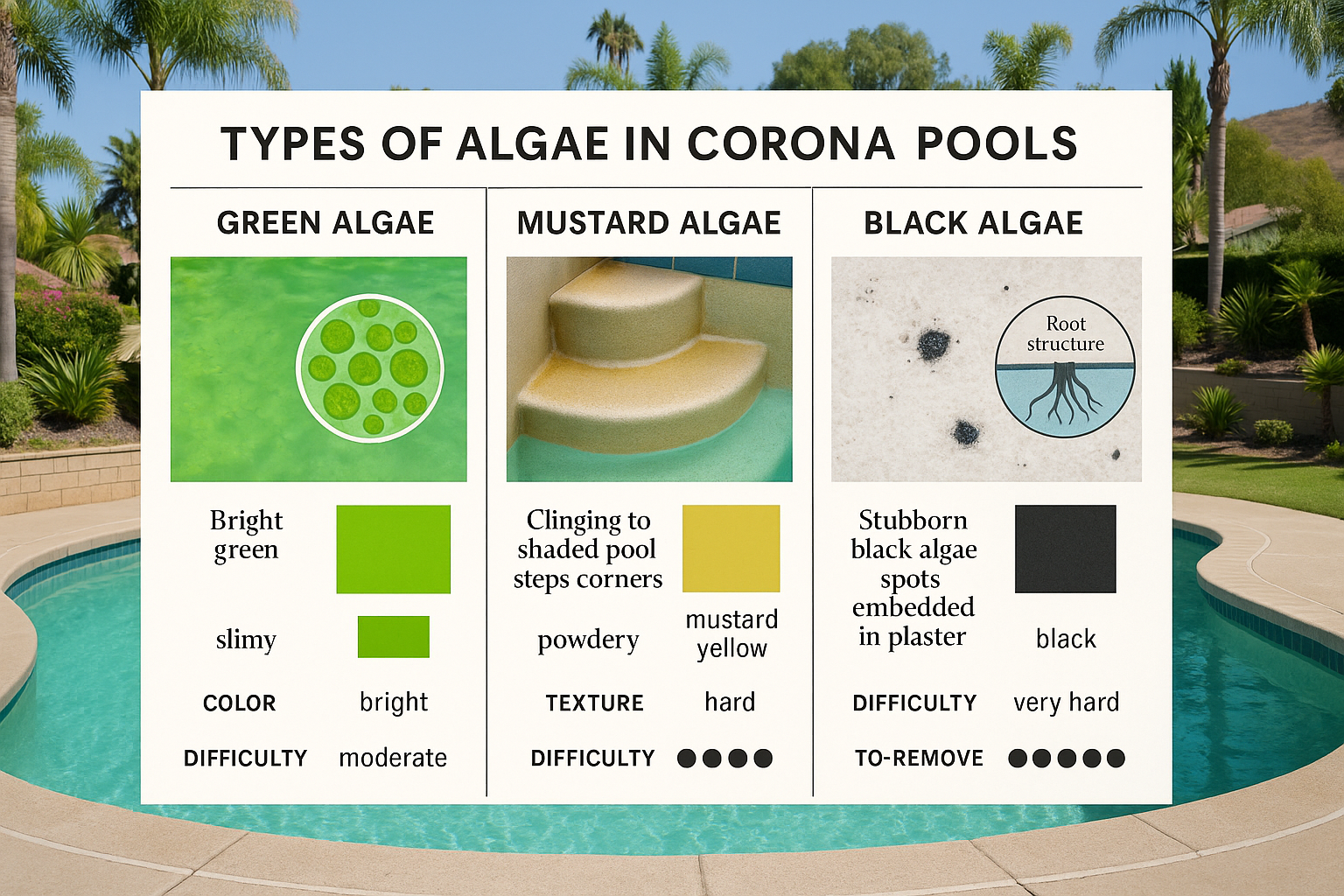
Not all algae are created equal, and identifying which type you’re dealing with is crucial for effective treatment. Here are the three main varieties of Cloudy Water & Algae in Corona pools:
Green Algae (Chlorophyta)
The most common type, green algae appears as a greenish tint in the water or bright green coating on pool walls and floors. It’s free-floating, which is why it clouds your water. Green algae is relatively easy to eliminate with proper shocking and brushing, but it spreads rapidly in warm water.
Visual signs:
Water has a greenish tint or is completely green
Slippery coating on pool surfaces
Cloudy water that won’t clear with filtration alone
Visible floating particles
Mustard/Yellow Algae
This sneaky variety looks like sand or pollen settled on your pool floor, typically in shaded areas. Mustard algae is chlorine-resistant and often returns even after treatment if you don’t follow specific protocols. It’s more common in Corona pools that have partial shade from trees or structures.
Visual signs:
Yellow or brownish-yellow patches on pool floor
Concentrated in shaded corners and on steps
Brushes away easily but returns quickly
Often mistaken for dirt or sand
Black Algae (Cyanobacteria)
The most stubborn variety, black algae forms dark blue-green or black spots with protective layers and deep roots that penetrate pool plaster. Black algae is technically a bacteria, not true algae, which is why it’s so difficult to eliminate. It requires aggressive brushing, specialized algaecides, and sometimes professional intervention.
Visual signs:
Small black or dark blue-green spots (pin-head to quarter-sized)
Rough texture when you run your hand over it
Roots embedded in pool surface
Resistant to normal chlorine levels
Behavioral Differences
Understanding how these algae behave helps you prevent them:
Green algae loves warm, stagnant water and blooms rapidly during heat waves
Mustard algae prefers shaded areas and survives in higher chlorine levels
Black algae establishes in rough surfaces and cracks, creating protective colonies
Weekly Maintenance Checklist for Clear Water
Consistency is everything when preventing Cloudy Water & Algae in Corona pools. Here’s my proven weekly maintenance routine that keeps pools crystal clear:
Monday: Skim + Vacuum
✅ Skim the surface to remove leaves, insects, and floating debris ✅ Vacuum the pool floor, paying special attention to corners and steps ✅ Empty skimmer and pump baskets to maintain optimal circulation ✅ Check water level—should be halfway up the skimmer opening
Wednesday: Brush Walls and Steps
✅ Brush all pool surfaces, including walls, steps, benches, and behind ladders ✅ Focus on low-circulation areas where algae starts forming ✅ Use a stainless steel brush for stubborn spots or plaster pools ✅ Brush toward the main drain so debris can be filtered out
Friday: Balance Water Chemistry
✅ Test chlorine levels (target: 2.0-4.0 ppm) ✅ Test pH (target: 7.2-7.4 for optimal chlorine effectiveness) ✅ Check stabilizer/cyanuric acid (target: 30-50 ppm) ✅ Test total alkalinity (target: 80-120 ppm) ✅ Add chemicals as needed and allow circulation before swimming
Saturday: Clean Filters
✅ Check filter pressure gauge ✅ Backwash sand or DE filters if pressure is 8-10 PSI above baseline ✅ Rinse cartridge filters or replace if more than 1 year old ✅ Inspect filter for damage or wear
As Needed: Shock Treatment
✅ Shock weekly during heavy use or after storms ✅ Shock immediately if water appears cloudy or has chlorine odor ✅ Always shock at dusk or night to prevent UV degradation ✅ Run pump for 8+ hours after shocking
“The single biggest mistake Corona pool owners make is inconsistent testing during summer months. When temperatures exceed 95°F, I recommend testing chemistry every 2-3 days instead of weekly—it’s the difference between a clear pool and a green swamp.” – Professional Pool Service Technician
How to Prevent Algae Growth in Corona Pools
Prevention is infinitely easier than remediation when it comes to Cloudy Water & Algae in Corona pools. Here are my top strategies:
Maintain Proper Chlorine Residual
Free chlorine is your primary algae prevention tool. In Corona’s warm climate, maintain levels at the higher end of the acceptable range (3.0-4.0 ppm) during summer months. The intense UV exposure and high temperatures deplete chlorine rapidly—sometimes reducing levels by 50% in just 24 hours[5].
Pro tip: Test chlorine in the morning before the sun hits your pool to get accurate readings of overnight consumption.
Regular Brushing of High-Traffic Areas
I can’t stress this enough: brushing prevents algae from establishing colonies. Even with perfect chemistry, algae can attach to pool surfaces and begin forming protective layers. Daily brushing of steps, benches, corners, and behind ladders disrupts this process and keeps surfaces algae-free.
Focus on:
🎯 Pool steps and entry areas
🎯 Shaded corners and walls
🎯 Around return jets and skimmers
🎯 Behind ladders and handrails
🎯 Bench seating and tanning ledges
Use Algaecides During High-Risk Months
Preventative algaecide treatments provide an extra layer of protection during Corona’s brutal summer months (June-September). I recommend using a quality quaternary ammonium algaecide weekly or a long-lasting polyquat algaecide monthly.
⚠️ Important: Algaecides supplement chlorine but don’t replace it. Maintain proper chlorine levels even when using algaecides.
Keep Phosphate Levels Low
Phosphates are algae fertilizer, entering your pool through lawn fertilizers, leaves, and even some pool chemicals. When phosphate levels exceed 500 ppb, algae growth accelerates dramatically[6]. Consider testing phosphates monthly and using a phosphate remover if levels are elevated.
Never Turn Off Pumps During Heat Waves
I understand the temptation to save electricity during expensive summer months, but running your pump is non-negotiable for preventing cloudy water and algae. During heat waves, I actually recommend increasing circulation time to 10-12 hours daily to maintain proper filtration and chemical distribution.
Should You Shock Your Pool in Corona’s Climate?
Absolutely—but timing and technique matter significantly in our warm climate.
When and How Often to Shock
Shock your pool weekly during summer in Corona, regardless of how clear it looks. High temperatures, heavy use, and intense UV exposure create a constant demand for oxidation. Additionally, shock immediately after:
🌊 Heavy rain or windstorms
🌊 Pool parties or high bather loads
🌊 Detecting chlorine odor (indicates chloramines)
🌊 Water appears dull or slightly cloudy
🌊 Combined chlorine exceeds 0.5 ppm
Best Times to Apply (Night vs Day)
Always shock at dusk or after sunset. Corona’s intense sunlight rapidly degrades chlorine—shocking during the day wastes chemicals and reduces effectiveness. By shocking at night, you give chlorine 8-10 hours to work before UV exposure begins.
The overnight shocking process:
Test and balance pH to 7.2-7.4 first
Apply shock around sunset
Run pump continuously overnight
Test chlorine in morning
Safe to swim when chlorine drops below 5 ppm
Liquid vs Granular Shock
Both have advantages in Corona’s climate:
Liquid chlorine (sodium hypochlorite):
✅ Dissolves instantly—no waiting
✅ Doesn’t raise cyanuric acid levels
✅ Won’t cloud water
❌ Degrades quickly in heat—use fresh product
❌ Raises pH slightly
Granular shock (calcium hypochlorite):
✅ More stable in storage
✅ Higher available chlorine percentage
✅ Longer shelf life in Corona’s heat
❌ Can temporarily cloud water
❌ Increases calcium hardness over time
For Corona pools, I generally prefer liquid chlorine for regular shocking and reserve cal-hypo for severe algae blooms.
Common Mistakes That Cause Cloudy Water
Even experienced pool owners make these errors that lead to persistent Cloudy Water & Algae in Corona problems:
Overuse of Clarifiers
Clarifiers are a band-aid, not a solution. While they temporarily improve water clarity by clumping particles together, overuse can actually make cloudiness worse by overwhelming your filter. Address the root cause—improper chemistry or poor filtration—instead of relying on clarifiers.
Poor Circulation Time Settings
Many Corona pool owners run their pumps only 4-6 hours daily to save electricity. This is insufficient during warm months. Your pump should run long enough to turn over all pool water at least once daily—typically 8-10 hours for most residential pools, and up to 12 hours during heat waves.
A dirty filter can’t effectively remove the particles causing cloudiness. Check your filter pressure weekly and clean when pressure rises 8-10 PSI above the clean baseline. In Corona’s dusty environment, this often means cleaning every 2-3 weeks during summer.
Not Brushing Walls Regularly
I’ve said it before, but it bears repeating: brushing is essential. Algae and biofilm attach to surfaces where your filter can’t reach them. Even with perfect chemistry, neglecting to brush allows algae to establish protected colonies that eventually bloom into cloudy, green water.
Ignoring Early Warning Signs
Cloudy water doesn’t appear overnight—there are always early indicators:
🚩 Water looks slightly dull or hazy
🚩 Pool floor isn’t as visible as usual
🚩 Slight chlorine odor
🚩 Slippery spots on steps or walls
🚩 Difficulty maintaining chlorine levels
Address these signs immediately rather than waiting for full-blown cloudiness or algae blooms.
Saltwater Pools: Algae Prevention Tips
Saltwater pools aren’t immune to Cloudy Water & Algae in Corona—in fact, they face unique challenges in our climate.
Salt Cell Maintenance
Your salt chlorine generator (SCG) produces chlorine by electrolysis, but Corona’s hard water causes calcium scale buildup on the cell plates, reducing efficiency[7]. Inspect your cell monthly and clean it when you notice white scale deposits.
Cleaning process:
Turn off pump and remove cell
Mix 1 part muriatic acid to 4 parts water in a bucket
Submerge scaled end of cell for 15-20 minutes
Rinse thoroughly and reinstall
Never use metal tools to scrape plates
Adjusting for Salinity Loss Due to Evaporation
Here’s a counterintuitive fact: evaporation doesn’t remove salt. When water evaporates in Corona’s heat, salt concentration actually increases. However, when you add fresh water to compensate for evaporation, you dilute the salt level.
Test salinity monthly and maintain 2700-3400 ppm for optimal chlorine production. Add pool-grade salt as needed, allowing 24 hours for complete dissolution and distribution.
Special Algaecides for Salt Systems
Not all algaecides are compatible with saltwater systems. Avoid copper-based algaecides, which can stain pool surfaces and damage the salt cell. Instead, use:
Enzyme-based products for organic matter breakdown
Don’t Assume Your SCG Handles Everything
The biggest misconception about saltwater pools: “They maintain themselves.” Your SCG only produces chlorine—you still need to:
Monitor and adjust pH (salt systems tend to raise pH)
Maintain proper cyanuric acid levels
Balance alkalinity and calcium hardness
Brush and vacuum regularly
Clean filters on schedule
How Brookside Pool Service Keeps Corona Pools Clear Year-Round
Professional pool service isn’t just about convenience—it’s about expertise and consistency that prevents Cloudy Water & Algae in Corona pools before problems start.
Weekly Visits
Our technicians visit your property every week, regardless of weather or season. This consistency ensures we catch small chemistry imbalances or equipment issues before they escalate into expensive problems. Each visit includes:
Complete surface skimming and debris removal
Thorough brushing of all pool surfaces
Vacuuming pool floor and steps
Emptying skimmer and pump baskets
Visual equipment inspection
Comprehensive Water Testing
We test 8-10 chemical parameters during each visit, far beyond the basic chlorine and pH that most homeowners check. Our testing includes:
Free and combined chlorine
pH levels
Total alkalinity
Calcium hardness
Cyanuric acid (stabilizer)
Salt levels (for saltwater pools)
Phosphates (monthly)
Total dissolved solids (quarterly)
Filter Backwashing and Maintenance
Proper filter maintenance is crucial in Corona’s dusty environment. We monitor filter pressure, backwash or clean filters on schedule, and inspect for damage or wear. We also track when filter media (sand, cartridges, or DE) needs replacement—typically every 3-5 years depending on usage.
Proactive Algae Prevention Plan
Rather than reacting to algae blooms, we implement a year-round prevention strategy tailored to Corona’s climate:
Heat wave protocols: More frequent testing, extended pump run times, shock treatments
Post-storm service: Emergency visits after Santa Ana winds or rare summer storms
Monthly phosphate control: Testing and treatment to eliminate algae nutrients
Equipment Expertise
Our technicians are trained to identify equipment issues that contribute to cloudy water:
Pump problems reducing circulation
Leaking valves causing chemistry imbalances
Aging salt cells producing insufficient chlorine
Timer malfunctions shortening circulation periods
Heater issues affecting water chemistry
We provide detailed recommendations and can coordinate repairs, saving you time and preventing water quality problems.
FAQs About Pool Water Clarity & Algae in Corona
“Is cloudy water safe to swim in?”
Generally, no. Cloudy water indicates either chemical imbalance or high bacteria/algae levels—both potentially harmful. The cloudiness itself prevents you from seeing swimmers in distress, creating a safety hazard. Don’t allow swimming until water is crystal clear and chemistry is balanced[8].
“How long does it take to clear green pool water?”
Typically 3-7 days for a moderately green pool in Corona’s climate, following this process:
Day 1: Heavy shock treatment (2-3x normal dose)
Days 2-3: Continued shocking and brushing
Day 4: Vacuum dead algae to waste
Days 5-7: Fine-tuning chemistry and filtration
Severely green pools or those with black algae may take 2-3 weeks. Professional service can often accelerate this timeline.
“Do salt pools get algae?”
Absolutely. Saltwater pools produce chlorine differently than traditional pools, but they’re equally susceptible to algae if chlorine levels drop or maintenance is neglected. The misconception that “salt kills algae” causes many Corona saltwater pool owners to experience algae blooms.
“Why does my pool keep getting cloudy even with good chemistry?”
Likely a filtration issue. If your chemistry tests perfect but water remains cloudy, check:
Filter cleanliness and pressure
Pump operation and flow rate
Circulation time (should be 8-10+ hours daily)
Return jet direction (should promote circulation)
Dead zones where water doesn’t circulate
Sometimes the filter media itself needs replacement, or you may need a larger/more efficient filter for your pool size.
“Can I prevent algae without using algaecide?”
Yes, but it requires perfect execution. Maintaining chlorine at 3.0-4.0 ppm, pH at 7.2-7.4, daily brushing, and proper circulation will prevent algae without algaecide. However, in Corona’s challenging climate, algaecide provides valuable insurance during heat waves, vacations, or equipment malfunctions.
Book a Free Water Quality Assessment in Corona, CA
Don’t let Cloudy Water & Algae in Corona ruin another summer. Brookside Pool Service offers complimentary water quality assessments for Corona-area homeowners, including:
✨ Comprehensive 10-point water chemistry analysis ✨ Equipment performance evaluation ✨ Customized maintenance plan for your specific pool and usage patterns ✨ Written report with actionable recommendations ✨ No-obligation service quote
Our Corona Service Areas
We proudly serve all Corona ZIP codes and neighborhoods:
92879 (Corona Hills, South Corona)
92880 (Downtown Corona, Dos Lagos)
92881 (North Corona, Sycamore Creek)
92882 (Green River, Eagle Glen)
92883 (Temescal Valley)
Why Choose Brookside Pool Service?
🏆 Licensed and Insured – Full liability coverage protects your property 🏆 15+ Years Experience – Specialized expertise in Corona’s unique climate challenges 🏆 5-Star Reviews – Hundreds of satisfied customers across the Inland Empire 🏆 Transparent Pricing – No hidden fees or surprise charges 🏆 Guaranteed Results – We stand behind our work with a satisfaction guarantee
Ready to enjoy crystal-clear water all year? Call us at (951) 555-POOL or visit our website to schedule your free assessment. Same-day emergency service available for severe algae blooms or equipment failures.
Conclusion
Maintaining crystal-clear pool water in Corona’s challenging warm climate doesn’t have to be an endless battle. By understanding why Cloudy Water & Algae in Corona pools are so common—high temperatures, rapid evaporation, intense UV exposure, and dust—you can implement targeted prevention strategies that keep your pool sparkling year-round.
The key takeaways for Corona pool owners:
Test frequently (at least twice weekly during warm months), maintain proper chemistry (chlorine 2.0-4.0 ppm, pH 7.2-7.4), brush daily to prevent algae colonies, ensure adequate circulation (8-12 hours daily in summer), and address problems immediately before they escalate.
Remember that consistency matters more than intensity. A pool that receives regular weekly maintenance will always outperform one that gets sporadic attention, regardless of how thorough that occasional service might be.
Your Action Plan for This Week
Test your water chemistry today – Don’t wait until the weekend
Inspect your filter pressure – Clean or backwash if needed
Brush all pool surfaces – Pay special attention to steps and corners
Evaluate your circulation time – Increase to 10+ hours if you’re experiencing cloudiness
Schedule professional service – If you’re struggling with persistent issues
Corona’s warm climate creates unique challenges, but with the right knowledge and consistent effort, you can enjoy a pristine backyard oasis that’s always ready for swimming. Whether you choose to maintain your pool yourself or partner with professional service, the principles remain the same: proper chemistry, adequate circulation, regular cleaning, and proactive prevention.
Don’t let another day go by staring at cloudy, uninviting water. Take action today, and you’ll be swimming in crystal-clear water by next weekend. Your backyard paradise is waiting! 🏊♂️💧
References
[1] Centers for Disease Control and Prevention. (2023). “Pool Chemistry and Water Quality.” CDC Healthy Swimming Program.
[2] California Pool & Spa Association. (2024). “Water Conservation and Evaporation Rates in Southern California Pools.”
[3] World Health Organization. (2024). “Guidelines for Safe Recreational Water Environments: Swimming Pools and Similar Environments.”
[4] Association of Pool & Spa Professionals. (2023). “Water Chemistry for Pool Professionals: Calcium Hardness Management.”
[5] National Swimming Pool Foundation. (2024). “Chlorine Degradation Rates Under UV Exposure.”
[6] Taylor Technologies. (2023). “The Role of Phosphates in Pool Water Quality.”
[7] Salt Chlorine Generator Manufacturers Association. (2024). “Maintenance Best Practices for Salt Systems.”
[8] American Red Cross. (2025). “Swimming Pool Safety and Water Quality Standards.”