Picture this: It’s a gorgeous Saturday morning in 2025, you’re ready to dive into your pool for the first time this season, and… nothing. The pump won’t start. The water looks murky. Your heater is making a sound like a dying whale. 🐋 We’ve all been there, and it’s frustrating! But here’s the good news—understanding Pool Equipment Repair & Replacement doesn’t have to be overwhelming. Whether you’re dealing with a minor hiccup or facing a complete system overhaul, I’m here to walk you through everything you need to know to keep your backyard oasis running smoothly.
Key Takeaways
- Pool equipment typically lasts 10-20 years depending on the component, with pumps averaging 8-12 years and filters lasting 10-20 years
- Repair vs. replacement decisions should factor in equipment age, frequency of breakdowns, energy efficiency, and parts availability
- Complete system replacement costs $8,000-$15,000 in 2025, while most pool owners spend $2,000-$4,000 every 5 years on equipment replacement[1]
- Spring is the best time to replace pool equipment—before opening season when professionals have better availability and you have time to research options
- Professional installation ensures warranty coverage and proper setup, though simple repairs like basket cleaning can be DIY projects
Why Pool Equipment Matters More Than You Think
Let’s get real for a second. Your pool isn’t just a fancy water feature—it’s a complex ecosystem that requires several key components working in perfect harmony. The pump circulates water, the filter removes debris and contaminants, the heater maintains comfortable temperatures, and your sanitization system keeps bacteria at bay.
When even one piece of this puzzle fails, the domino effect can be significant. A malfunctioning pump means stagnant water, which becomes a breeding ground for algae and bacteria. A broken heater might not seem urgent until you realize you can’t use your pool for half the year. And a failing filter? That’s your ticket to cloudy, uninviting water that nobody wants to swim in.
The bottom line: Investing in proper Pool Equipment Repair & Replacement isn’t just about fixing problems—it’s about protecting your investment and ensuring your pool remains the relaxing retreat you envisioned when you first installed it.
Understanding Your Pool Equipment Lifespan
One of the most common questions I hear is, “How long should my pool equipment actually last?” Great question! Let’s break down the typical lifespan and costs for each major component:
Pool Pumps 💪
Your pool pump is the hardest-working piece of equipment you own. Running several hours daily, it’s no wonder these workhorses eventually wear out.
- Lifespan: 8-12 years with proper maintenance[1]
- Replacement cost: $2300-$3,000 for the complete unit
- Motor-only replacement: $400 to $500 for parts, plus $150-$300 in labor[1]
- Installation time: 2-3 hours with professional labor costs of $300-$500[1]
Pro tip: If your pump is over 10 years old and needs a major repair, replacement often makes more financial sense than fixing it.
Pool Filters: The Three Types
Not all filters are created equal! Here’s what you need to know about each type:
| Filter Type | Equipment Cost | Installation | Lifespan | Maintenance |
|---|---|---|---|---|
| Sand Filter | $300-$1,200 | $200-$400 | 15-20 years | Sand replacement every 5 years ($100-$200)[1] |
| Cartridge Filter | $400-$1,500 | $200-$400 | 8-12 years | Cartridge replacement every 2 years ($150-$400)[1] |
| DE Filter | $700-$2,000 | $300-$500 | 10-15 years | DE powder yearly ($50-$100)[1] |
Sand filters are the most durable long-term investment, while cartridge filters offer the easiest maintenance. DE (diatomaceous earth) filters provide the finest filtration but require more hands-on care.
Pool Heaters 🔥
Nothing beats jumping into a perfectly heated pool on a cool evening. But heaters work hard and don’t last forever.
- Lifespan: 7-10 years of regular use[1]
- Replacement cost: $2,000-$5,000[1]
- Annual maintenance: $150-$300 to keep it running efficiently[1]
If you’re experiencing inconsistent heating or your energy bills have skyrocketed, it might be time to consider replacement rather than another repair.
Salt Cell Systems
If you’ve upgraded to a saltwater pool system, you know how much easier maintenance becomes. However, the salt cell itself requires periodic replacement.
- Lifespan: 3-7 years depending on usage and water chemistry[1]
- Replacement cost: $1200 for cell systems,
Maintaining proper water chemistry significantly extends salt cell life, so staying on top of your pool cleaning checklist pays dividends here.
Pool Equipment Repair & Replacement: Making the Right Decision
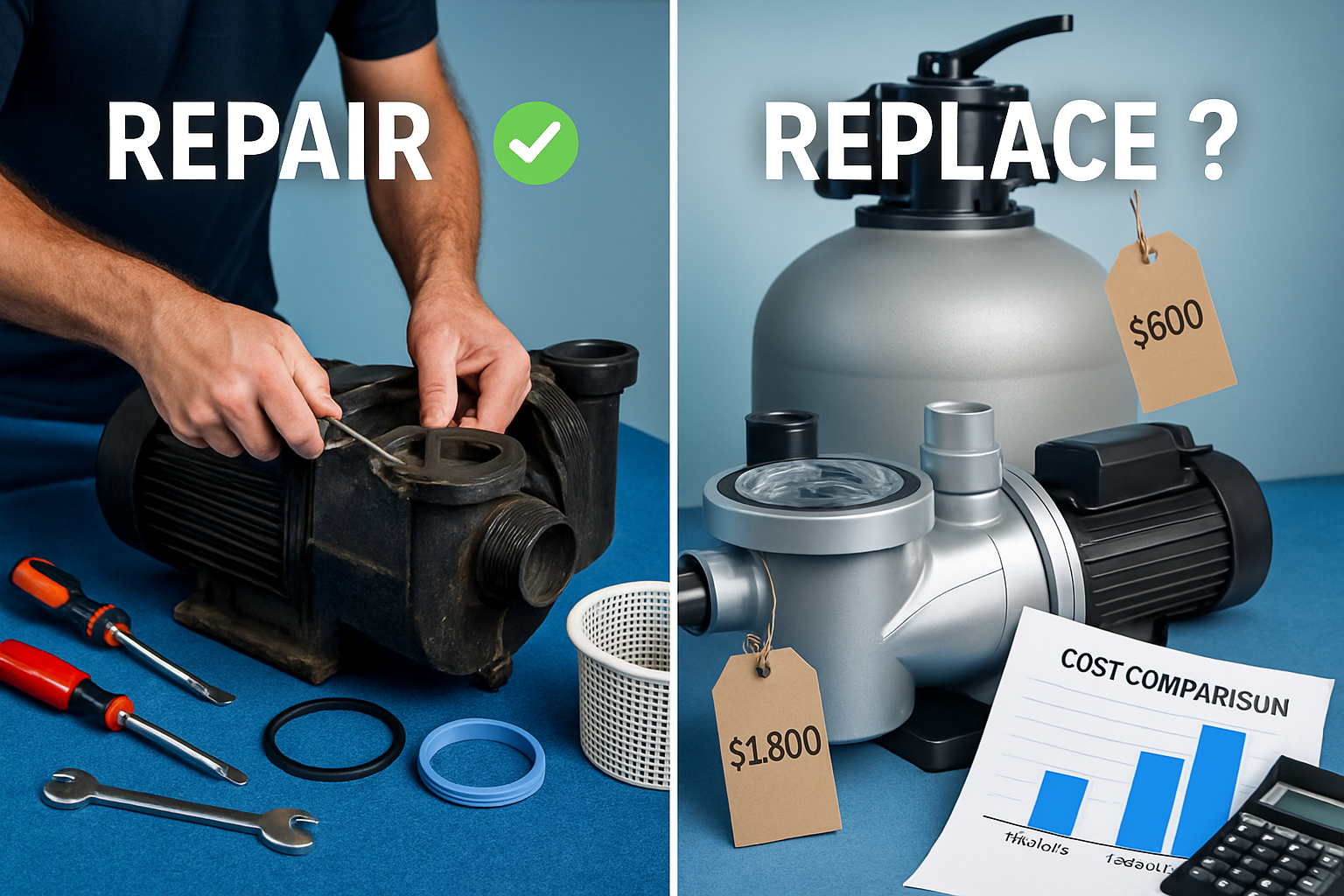
Here’s where things get tricky. You’ve got a broken component, and you need to decide: repair or replace? I’ve developed a simple framework to help you make this call:
When to Repair ✅
- Equipment is less than 5 years old and still under warranty
- The issue is minor (worn seal, clogged basket, simple electrical fix)
- Repair costs are less than 30% of replacement cost
- Parts are readily available and the fix is straightforward
- You’ve had no previous major repairs on this equipment
When to Replace 🔄
- Equipment is over 10 years old and showing multiple issues
- You’re experiencing frequent breakdowns (more than twice per season)
- Repair costs exceed 50% of replacement cost
- Parts are obsolete or difficult to source
- Energy efficiency is poor compared to modern alternatives
- You’re planning other pool upgrades that would benefit from new equipment
“The best time to replace pool equipment is right before opening the pool in spring during the off-season, allowing time for research, price comparison, and professional scheduling.”[1]
This timing gives you the advantage of contractor availability and ensures you’re not scrambling mid-summer when everyone needs service.
Common Pool Equipment Problems and Solutions
Let me walk you through some issues I see constantly and what they typically mean:
Pump Problems 🚨
Symptom: Loud grinding or screeching noises
Likely cause: Worn bearings or debris in the impeller
Solution: If bearings are worn, motor replacement ($200-$500) is usually needed. For debris, a simple cleaning might do the trick.
Symptom: Pump won’t prime or loses prime
Likely cause: Air leaks in suction lines or low water level
Solution: Check all connections for leaks, ensure skimmer baskets are clean, and verify water level is adequate.
Symptom: Pump runs but doesn’t circulate water
Likely cause: Clogged impeller or closed valves
Solution: Turn off power, remove pump housing, and clear impeller. Check all valves are in correct positions.
Filter Failures 🔍
Symptom: Cloudy water despite running pump
Likely cause: Dirty filter media or damaged filter elements
Solution: For sand filters, backwash thoroughly or replace sand if it’s been 5+ years. For cartridge filters, deep clean or replace cartridges. For DE filters, backwash and add fresh DE powder.
Symptom: High pressure reading on filter gauge
Likely cause: Clogged filter media
Solution: Backwash or clean filter. If pressure remains high after cleaning, media replacement is needed.
Heater Headaches 🌡️
Symptom: Heater won’t ignite
Likely cause: Thermostat issues, gas supply problems, or faulty ignition
Solution: Check thermostat settings, verify gas valve is open, inspect pilot light. Professional diagnosis often needed for safety.
Symptom: Heater runs but water doesn’t warm up
Likely cause: Scaled heat exchanger or insufficient flow
Solution: Descale heat exchanger or check for flow restrictions. This typically requires professional service.
DIY Pool Equipment Repair: What You Can Handle
I’m all for saving money, but safety comes first! Here are repairs most handy homeowners can tackle:
Safe DIY Repairs ✅
- Cleaning pump baskets and skimmers – Simple maintenance anyone can do
- Replacing pump lid O-rings – Inexpensive fix for minor leaks ($10-20 for parts)
- Backwashing filters – Essential regular maintenance
- Cleaning or replacing cartridge filters – Straightforward process
- Checking and adjusting chemical feeders – Basic maintenance task
- Tightening loose fittings – Prevents small leaks from becoming big problems
Leave to the Professionals ⚠️
- Electrical work – Pool electrical systems require specialized knowledge and permits
- Gas heater repairs – Safety hazard if done incorrectly
- Major plumbing modifications – Requires proper sizing and code compliance
- Pump motor replacement – Involves electrical connections and proper alignment
- Complete equipment installations – Ensures warranty coverage and proper setup
When you need professional help, finding reliable pool services makes all the difference in getting quality work at fair prices.
The True Cost of Pool Equipment Repair & Replacement in 2025
Let’s talk numbers. Understanding the full cost picture helps you budget appropriately and avoid sticker shock.
Individual Component Replacement Costs
Basic Costs:
- Pool pump replacement: $2500-$3,000
- Filter replacement: $1700-$2,000 (depending on type)
- Heater replacement: $4500-$5,800
- Salt cell replacement: $1300-$2,000
- Automation system: $2,500 +
Labor Costs:
- Pump installation: $300-$500 (2-3 hours)[1]
- Filter installation: $300-$400 (2-3 hours)[1]
- Complete system replacement: $1,500-$3,000 (8-12 hours)[1]
Additional Installation Expenses
Don’t forget these potential add-ons:
- Electrical work: $400-$1,000 for new circuits or upgrades[1]
- Replumbing: $500-$1,500 if equipment locations change or pipes need updating[1]
- Permit fees: $50-$300 depending on your location[1]
- Equipment pad/mounting: $200-$500 for concrete work if needed
Important note: Equipment with unions in the same location and matching dimensions allows straightforward installation, but misaligned connections may require replumbing work.[1]
Complete System Replacement
If you’re facing multiple equipment failures or building a new pool, here’s what a complete overhaul looks like:
- Total cost range: $8,000-$15,000 for all major equipment[1]
- Average homeowner spending: $2,000-$4,000 every 5 years on equipment replacement[1]
Understanding these pool service costs helps you plan for both routine maintenance and unexpected repairs.
Regional Cost Variations 🗺️
Where you live significantly impacts labor costs:
- Higher cost regions: California, Arizona, and Northeast states
- Moderate cost regions: Texas, Florida, and Southeast states
- Price difference: Can be 20-40% between high and low cost areas[1]
Always get multiple quotes from licensed contractors in your area to ensure competitive pricing.
Maximizing Your Pool Equipment Lifespan
Prevention really is better than cure! Here’s how to get the most years out of your equipment:
Regular Maintenance Schedule 📅
Weekly:
- Clean skimmer and pump baskets
- Check water level and top off if needed
- Test and balance water chemistry
- Inspect equipment for leaks or unusual noises
Monthly:3
- Deep clean filters (backwash or rinse cartridges)
- Inspect all equipment connections and fittings
- Check timer settings and operation
- Lubricate O-rings and gaskets
Seasonally:
- Professional equipment inspection
- Heater servicing before heating season
- Winterization procedures (if applicable)
- Replace worn parts before they fail
Annually:
- Complete system check by professional
- Replace sacrificial anodes in heaters
- Update automation software if applicable
- Plan for upcoming replacement needs
Water Chemistry: The Secret Weapon 💧
Proper water balance isn’t just about swimmer comfort—it dramatically affects equipment longevity:
- pH levels (7.2-7.6): Prevents corrosion and scaling
- Alkalinity (80-120 ppm): Buffers pH changes
- Calcium hardness (200-400 ppm): Prevents equipment deterioration
- Chlorine (1-3 ppm): Sanitizes without being corrosive
Aggressive water chemistry (too acidic or basic) can shorten equipment life by years. Following a proper summer pool maintenance checklist keeps everything balanced.
Winterization and Off-Season Care ❄️
If you close your pool seasonally, proper winterization protects your investment:
- Thoroughly clean all equipment before shutdown
- Drain water from pumps, filters, and heaters to prevent freeze damage
- Remove and store cartridge filters indoors
- Add antifreeze to plumbing lines in cold climates
- Cover equipment to protect from weather and debris
Check out these pool closing tips for a comprehensive winterization guide.
Upgrading vs. Replacing: When to Consider Modern Equipment
Sometimes replacement isn’t just about fixing what’s broken—it’s about upgrading to better technology. Here are scenarios where upgrading makes sense:
Energy Efficiency Upgrades 💡
Modern variable-speed pumps can reduce energy consumption by 50-75% compared to single-speed models. If you’re replacing a pump anyway, the upgrade pays for itself in 2-3 years through energy savings.
Benefits:
- Lower monthly operating costs
- Quieter operation
- Longer equipment life
- Potential utility rebates
Automation Systems 📱
Smart pool controllers let you manage everything from your smartphone:
- Schedule pump and heater operation
- Monitor water chemistry
- Control lighting and water features
- Receive maintenance alerts
If you’re replacing multiple components, adding automation during installation saves money versus retrofitting later.
Saltwater Conversion
When replacing your sanitization system, consider upgrading to saltwater:
- Gentler on skin and eyes
- Lower ongoing chemical costs
- More consistent chlorine levels
- Reduced maintenance time
Finding the Right Professional for Pool Equipment Repair & Replacement
Not all pool service companies are created equal. Here’s what to look for:
Essential Qualifications ✓
- Licensed and insured in your state
- Manufacturer certifications for major brands
- Minimum 5 years experience with residential pools
- Positive reviews from local homeowners
- Written warranties on parts and labor
- Transparent pricing with detailed estimates
Red Flags to Avoid 🚩
- Requires full payment upfront
- No physical business address
- Can’t provide references
- Pressure tactics or “limited time” deals
- Unwilling to pull permits when required
- Significantly lower prices than competitors (often indicates corners will be cut)
Getting multiple quotes helps you understand fair market pricing. Most professionals offer free estimates for replacement projects.
Warranty Considerations and Protection
Understanding warranties saves money and headaches down the road:
Manufacturer Warranties
- Pumps: Typically 1-3 years on parts
- Filters: 1-2 years on tank, varies on media
- Heaters: 1-5 years depending on component
- Salt cells: 3-5 years prorated
Critical: Professional installation is often required to maintain warranty coverage. DIY installation may void manufacturer warranties entirely.
Labor Warranties
Reputable contractors provide:
- 30-90 days on repair work
- 1 year on replacement installations
- Written warranty documentation
Always get warranty terms in writing before work begins.
Planning Your Pool Equipment Budget
Smart pool owners plan ahead for equipment replacement. Here’s a budgeting strategy:
Create a Replacement Fund 💰
Based on average spending of $2,000-$4,000 every 5 years[1], set aside:
- monthly for equipment replacement
- Additional annually for professional maintenance
- Emergency fund
Prioritize Replacements
If budget is tight, prioritize in this order:
- Pump – Nothing works without circulation
- Filter – Essential for water quality
- Sanitization system – Critical for safety
- Heater – Comfort item, can wait if necessary
- Automation/upgrades – Nice to have, not essential
Understanding how much pool services cost helps you budget for both DIY and professional maintenance.
Environmental Considerations in 2025
Modern pool equipment isn’t just more efficient—it’s more environmentally responsible:
Eco-Friendly Options 🌱
- Variable-speed pumps: Reduce energy consumption by up to 75%
- Solar heaters: Harness free energy from the sun
- Saltwater systems: Reduce chemical usage and packaging waste
- LED lighting: Uses 80% less energy than traditional bulbs
- Smart controllers: Optimize run times to minimize waste
Many utilities offer rebates for energy-efficient equipment upgrades, reducing your out-of-pocket costs by $100-$500.
Conclusion: Taking Control of Your Pool Equipment Future
Whew! We’ve covered a lot of ground, but here’s the truth: Pool Equipment Repair & Replacement doesn’t have to be stressful or overwhelming. With the right knowledge and planning, you can make informed decisions that protect your investment and keep your pool running beautifully for decades.
Your Action Plan for 2025 🎯
Right now:
- Inventory your equipment – Note ages, models, and condition of all components
- Create a maintenance schedule – Set reminders for regular cleaning and inspections
- Start a replacement fund – Even $50/month builds a cushion for future needs
- Research local professionals – Build relationships before emergencies strike
This season:
- Schedule a professional inspection – Get expert eyes on your system
- Address minor issues – Don’t let small problems become big ones
- Test water chemistry weekly – Protect your equipment from the inside out
- Document everything – Keep records of repairs, replacements, and maintenance
Long-term:
- Plan for replacements – Know what’s coming and budget accordingly
- Consider upgrades – Energy efficiency pays for itself
- Stay educated – Pool technology keeps improving
- Build professional relationships – Having trusted contractors makes everything easier
Remember, your pool is meant to be enjoyed, not stressed over. By staying proactive with maintenance and making smart decisions about repair versus replacement, you’ll spend less time worrying about equipment and more time making splash-worthy memories with family and friends.
Now get out there and enjoy that beautiful pool of yours—you’ve earned it! 🏊♂️☀️
References
[1] Pool equipment costs, lifespans, and replacement data based on 2025 industry averages from pool equipment manufacturers, professional pool service associations, and regional contractor pricing surveys.