Pool Company Corona CA: Your Complete Guide to Building, Hiring & Maintaining Your Pool in 2026
Last updated: May 22, 2026
Quick Answer: Hiring the right pool company in Corona, CA means finding a licensed contractor familiar with Riverside County permit requirements, local soil conditions, and the region's intense heat. Pool installation in Corona typically costs between $50,000 and $100,000+ depending on pool type and size, and takes 8 to 14 weeks from permit approval to first swim.
Key Takeaways
- Pool installation in Corona, CA ranges from roughly $50,000 for a basic fiberglass pool to $100,000+ for a custom gunite build.
- Riverside County requires building permits for all new pool construction — a reputable pool company handles this paperwork for you.
- Corona's clay-heavy, expansive soil can shift after rain, making proper excavation and engineering critical.
- Concrete (gunite) pools are the most popular choice in Corona's climate but cost more upfront; fiberglass pools install faster and cost less to maintain.
- Weekly pool maintenance in Corona runs $150 to $250 per month depending on pool size and service level.
- Always verify a contractor's C-53 Swimming Pool Contractor license through the California Contractors State License Board (CSLB).
- Ask at least five specific questions before signing any contract — including who pulls permits and what the payment schedule looks like.
- Financing options include home equity loans, contractor financing, and personal loans — each with different trade-offs.
How Much Does Pool Installation Cost in Corona, California?
Pool installation in Corona, CA costs between $50,000 and $120,000 for most residential projects in 2026. The wide range reflects pool type, size, features, and site conditions.
Here's a general cost breakdown by pool type:
| Pool Type | Estimated Cost Range | Notes |
|---|---|---|
| Fiberglass (pre-formed shell) | $50,000 – $70,000 | Faster install, lower long-term maintenance |
| Gunite/Concrete (custom shape) | $70,000 – $120,000+ | Most popular in Corona; fully customizable |
| Vinyl liner | $40,000 – $60,000 | Less common in Southern California |
Additional costs to budget for:
- Permits and inspections: $1,500 – $3,500
- Decking (travertine, concrete, pavers): $8,000 – $20,000
- Water features, lighting, automation: $3,000 – $15,000
- Landscaping after construction: $2,000 – $10,000
Common mistake: Many homeowners budget only for the pool shell and forget decking, fencing (required by California law for pools), and landscaping restoration. Add 20–25% to your base quote as a contingency.
How to Choose Between Pool Companies in Corona, CA
The best pool company in Corona, CA holds a valid C-53 Swimming Pool Contractor license, carries general liability and workers' compensation insurance, and has verifiable local references from Riverside County homeowners.
Five criteria to narrow your list:
- License verification — Search the contractor's name or license number at the CSLB website (cslb.ca.gov). A C-53 license is the specific classification for swimming pool contractors in California.
- Local experience — Ask how many pools they've built in Corona or the surrounding Inland Empire. Local experience matters because of soil and permit nuances.
- References and reviews — Request three to five recent references. Check Google, Yelp, and the Better Business Bureau.
- Written, itemized bids — Never accept a verbal quote. A proper bid lists labor, materials, permits, and a payment schedule.
- Communication style — If a contractor is slow to return calls before you sign, it won't improve after.
Choose a local pool company in Corona, CA if: You want someone who knows the Riverside County Building Department, understands local soil reports, and can pull permits without delays.
For ongoing care after your build, a reliable expert swimming pool service in Corona keeps your investment protected year-round.
What Types of Pools Do Local Companies Offer?
Most pool companies serving Corona offer three main pool types: gunite (concrete), fiberglass, and vinyl liner. Gunite dominates the local market because it allows fully custom shapes suited to Corona's varied lot sizes and backyard layouts.
Pool types explained:
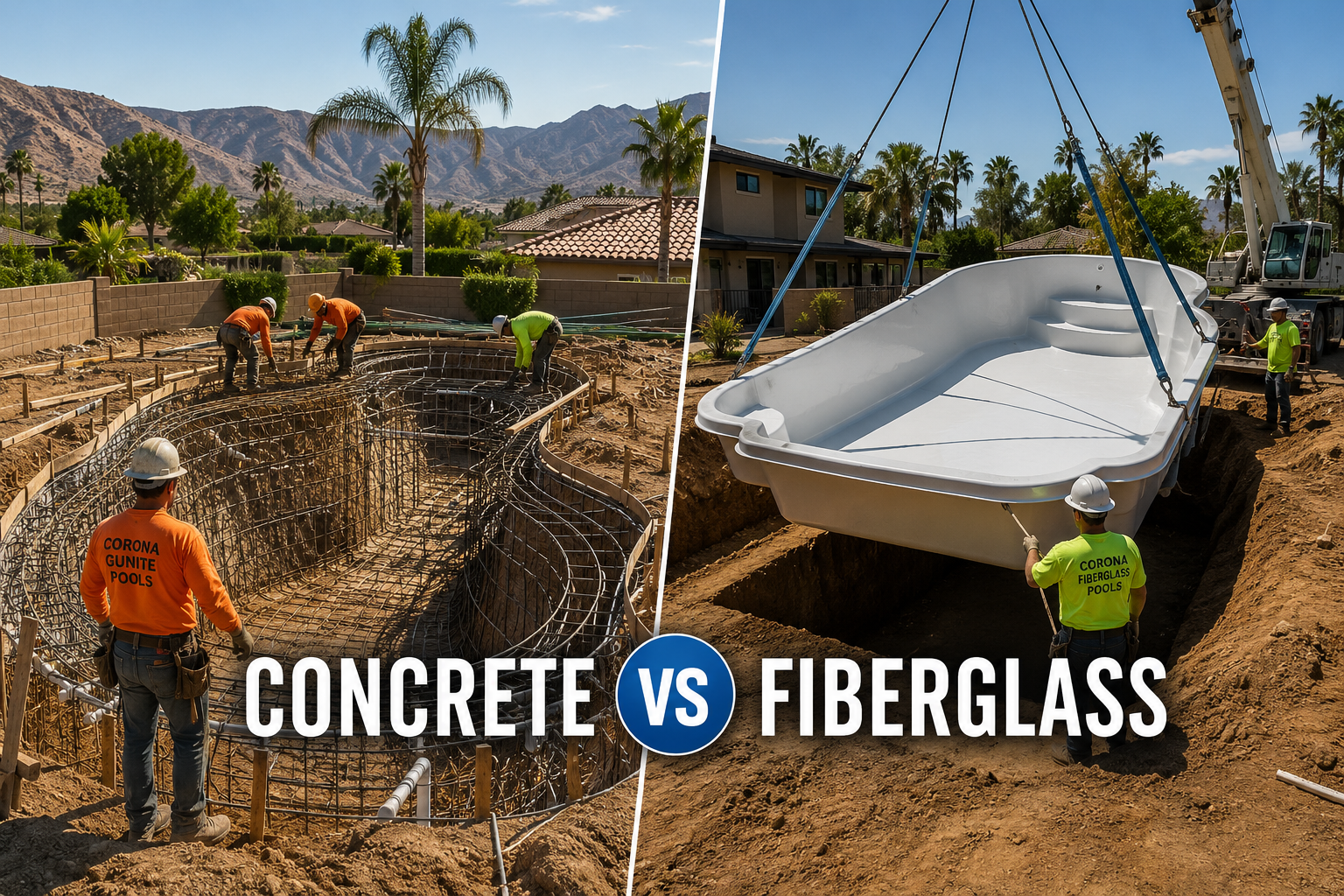
- Gunite/Shotcrete: Sprayed concrete formed around a rebar skeleton. Fully custom in shape, depth, and finish. Lasts 25–50 years with proper care.
- Fiberglass: A factory-molded shell dropped into an excavated hole. Limited shapes but installs in 2–4 weeks and has a smooth surface that resists algae.
- Vinyl liner: A custom-fitted liner over a frame. Least common in Southern California due to UV degradation and liner replacement costs every 8–12 years.
Popular add-ons Corona homeowners request:
- Baja shelves (tanning ledges)
- Spa/hot tub combos
- Salt chlorine generators (lower chemical costs long-term)
- LED color lighting
- Automated pool controls via smartphone app
Are Concrete or Fiberglass Pools Better for Corona's Climate?
For Corona's climate, gunite pools are generally the better long-term investment, but fiberglass pools offer real advantages in speed and maintenance costs. The right choice depends on your budget, timeline, and design goals.
Corona's climate factors that matter:
- Intense UV exposure: Both pool types handle UV well, but fiberglass gel coats can fade over 15–20 years.
- High heat: Water evaporates faster in Corona's summers (temperatures regularly exceed 100°F). Gunite pools can be built with any depth to offset this.
- Soil movement: Corona has expansive clay soils that shift with moisture changes. Gunite pools, when properly engineered with steel reinforcement, handle soil movement better than fiberglass shells, which can pop out of the ground if hydrostatic pressure isn't managed correctly.
Bottom line: If you want a custom shape and plan to stay in your home long-term, gunite is the stronger choice for Corona. If you want a faster build and lower chemical costs, fiberglass is worth serious consideration.
Average Pool Construction Timeline in Riverside County
From signed contract to first swim, most pool projects in Riverside County take 10 to 16 weeks. Permit approval from the City of Corona or Riverside County typically takes 3 to 6 weeks alone.
Typical construction phases:
- Design and contract signing: 1–2 weeks
- Permit application and approval: 3–6 weeks
- Excavation: 2–4 days
- Steel/rebar installation: 3–5 days
- Plumbing and electrical rough-in: 1 week
- Gunite or shell installation: 1–3 days (gunite cures for 28 days)
- Tile, coping, and decking: 2–3 weeks
- Plaster/finish and fill: 1 week
- Final inspection and startup: 3–5 days
Edge case: If your project requires a soils report (common on sloped lots or areas with known expansive clay), add 2–3 weeks to the timeline before permits are even submitted.
Do Pool Companies in Corona Handle Permit Paperwork?
Yes — any reputable pool company in Corona, CA should pull all required permits on your behalf as part of their contract. In California, it is actually illegal for a homeowner to pull permits for work done by a licensed contractor in most cases.
What permits are typically required:
- Building permit (City of Corona or Riverside County, depending on your address)
- Electrical permit
- Plumbing permit
- Barrier/fencing compliance inspection (required by California Health and Safety Code)
Red flag: If a contractor asks you to pull your own permits or suggests skipping them to "save time," walk away. Unpermitted pools create serious problems when you sell your home and can result in fines or mandatory pool removal.
Pool Construction Challenges in Corona's Soil and Terrain
Corona's soil presents real engineering challenges that affect pool design, cost, and longevity. The region sits in the Inland Empire where clay-rich, expansive soils are common, and some hillside lots have bedrock close to the surface.
Key challenges:
- Expansive clay: Absorbs water and swells, then shrinks when dry. This movement can crack pool shells or shift plumbing if not accounted for in the structural design.
- Rocky terrain: Some areas of Corona (particularly near the foothills) require jackhammering through rock during excavation, adding $2,000–$8,000 to costs.
- Sloped lots: Require retaining walls or additional engineering, which adds cost but can create stunning elevated pool designs.
- High water table: Less common in Corona but possible near low-lying areas; affects fiberglass pool installation more than gunite.
Ask your pool company whether they require a soils report for your specific address. A good contractor will tell you upfront.
Pool Maintenance Costs for Residential Pools in Corona
Weekly pool maintenance in Corona costs $150 to $250 per month for a standard residential pool in 2026. That range covers chemical balancing, skimming, brushing, and equipment checks.
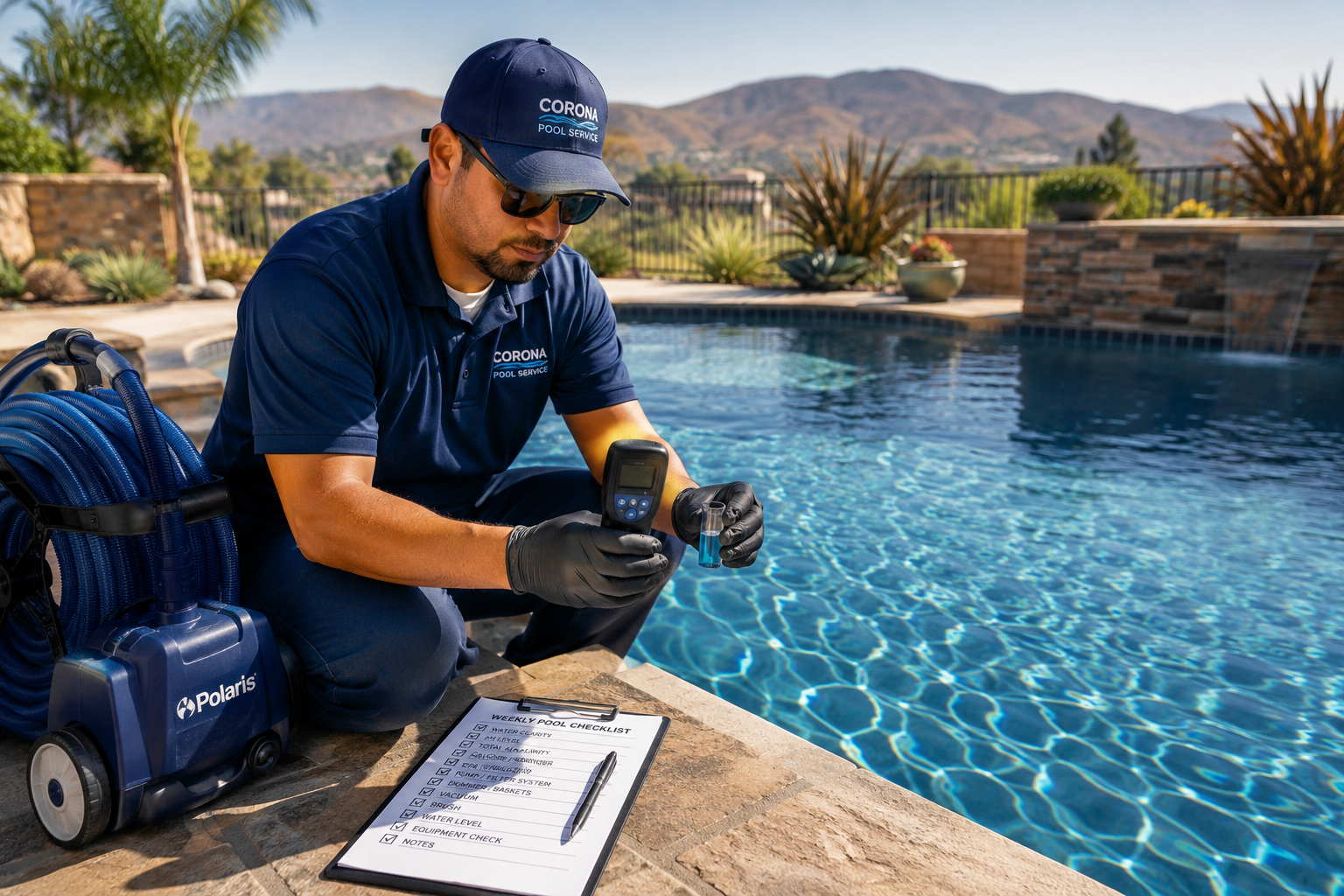
What's typically included in a monthly service plan:
- Weekly chemical testing and balancing
- Skimming and vacuuming
- Filter cleaning (periodic)
- Equipment visual inspection
Additional maintenance costs to expect:
- Filter cleaning service: $75–$150 per service
- Pool pump repair or replacement: $200–$1,500+ depending on the issue
- Acid wash (every 3–5 years): $300–$600
Corona's heat means pools run their pumps longer, chemicals deplete faster, and algae can bloom quickly if service is skipped. Consistent weekly pool cleaning in Corona prevents the much more expensive problem of a green pool recovery.
For equipment issues that come up, pool equipment repair and replacement in Corona, CA is a service worth having on speed dial.
Pool Installation Options for Small Backyards in Corona
Small backyards in Corona can absolutely accommodate a pool — the key is choosing the right size and shape. Plunge pools, cocktail pools (typically 10×20 feet or smaller), and L-shaped designs work well in tight spaces.
Options for compact lots:
- Plunge pools: 8–10 feet wide, 12–15 feet long. Great for cooling off and hydrotherapy. Cost: $30,000–$55,000.
- Cocktail pools: Slightly larger than plunge pools, often with a built-in spa. Cost: $40,000–$70,000.
- Lap pools: Long and narrow (8×40 feet). Ideal for narrow side yards.
- Spool (spa + pool combo): A compact unit that functions as both a hot tub and small pool.
Tip: In Corona, many smaller lots are in newer tract home developments. Check your HOA rules before designing — some HOAs restrict pool placement, fencing styles, or equipment visibility.
Financing Options for Pool Installation in Corona
Most homeowners in Corona finance their pool through a home equity loan, home equity line of credit (HELOC), or contractor-arranged financing. Each option has different interest rates, approval timelines, and risks.
Common financing options:
| Option | Pros | Cons |
|---|---|---|
| Home equity loan | Fixed rate, predictable payments | Requires sufficient home equity |
| HELOC | Flexible draw schedule | Variable rate; tied to your home |
| Contractor financing | Fast approval, no home equity needed | Often higher interest rates |
| Personal loan | No home collateral required | Higher rates, shorter terms |
| Cash-out refinance | Can roll into mortgage | Closing costs; resets mortgage |
Practical advice: Get pre-approved for financing before you start collecting pool bids. Knowing your budget ceiling prevents the common mistake of falling in love with a $100,000 design when your budget is $65,000.
What Questions Should I Ask Before Hiring a Pool Contractor?
Before signing with any pool company in Corona, CA, ask these specific questions to separate serious contractors from unreliable ones.
10 questions to ask every contractor:
- What is your C-53 license number, and can I verify it?
- Do you carry general liability and workers' compensation insurance?
- Will you pull all required permits for this project?
- Who is the actual project manager, and how often will they be on-site?
- What is the payment schedule, and what percentage is due upfront? (Never pay more than 10% or $1,000 upfront, per California law.)
- What is your estimated timeline from permit approval to completion?
- Do you use subcontractors? If so, are they licensed and insured?
- What does your warranty cover, and for how long?
- Can you provide three references from Corona or Riverside County homeowners?
- What happens if there are soil or site conditions that change the scope of work?
For more guidance on vetting local contractors, see this resource on how to choose a reliable pool service company in Corona.
Common Mistakes Homeowners Make When Building a Pool
The most common mistake Corona homeowners make is underestimating total project cost by forgetting fencing, decking, and landscaping. The second most common is choosing a contractor based on price alone.
Mistakes to avoid:
- Skipping the soils report: On expansive clay lots, this is not optional.
- Choosing the lowest bid without scrutiny: A bid $15,000 below competitors usually means something is missing or cut.
- Not planning for ongoing maintenance: A pool that costs $80,000 to build costs $2,000–$3,000 per year to maintain properly.
- Ignoring energy efficiency: An older single-speed pump can cost $100+ per month to run. A variable-speed pump upgrade pays for itself within 2–3 years in Corona's climate.
- Starting construction before permits are approved: Delays are frustrating; stop-work orders are worse.
FAQ: Pool Company Corona CA
Q: Do I need a permit to build a pool in Corona, CA?
Yes. All new pool construction in Corona requires building, electrical, and plumbing permits from the City of Corona or Riverside County. Your licensed pool contractor should pull these permits as part of the project.
Q: How long does it take to build a pool in Corona?
Most projects take 10 to 16 weeks from contract signing to completion. Permit approval alone takes 3 to 6 weeks in Riverside County.
Q: What is the cheapest type of pool to install in Corona?
Fiberglass pools generally have the lowest installation cost, starting around $50,000 installed. Vinyl liner pools can be cheaper but are less common and less durable in Southern California's climate.
Q: How do I verify a pool contractor's license in California?
Visit cslb.ca.gov and search by contractor name or license number. Look for a C-53 classification specifically for swimming pool contractors.
Q: Can I build a pool in a small Corona backyard?
Yes. Plunge pools, cocktail pools, and lap pools are designed for compact spaces. A pool as small as 8×12 feet is buildable in most backyards.
Q: How much does weekly pool service cost in Corona, CA?
Expect to pay $150 to $250 per month for standard weekly Corona pool maintenance that includes chemicals, cleaning, and equipment checks.
Q: What is the maximum down payment a pool contractor can legally request in California?
California law caps the initial deposit at 10% of the total contract price or $1,000, whichever is less. Any contractor demanding more upfront is violating state law.
Q: Are saltwater pools a good option in Corona?
Yes. Saltwater pools are popular in Corona because they reduce chemical costs and are gentler on skin and eyes. The salt chlorine generator does require periodic maintenance. See our guide on saltwater pool service in Corona for details.
Q: What pool pump should I use in Corona's climate?
Variable-speed pumps are strongly recommended. They use significantly less energy than single-speed pumps, and California's Title 20 regulations now require variable-speed pumps for most new pool installations.
Q: How often should I have my pool filter cleaned in Corona?
In Corona's dusty, high-heat environment, most pool filters need professional cleaning every 3 to 6 months. Regular pool filter cleaning in Corona, CA extends equipment life and keeps water clear.
Q: Does my pool need a fence in California?
Yes. California Health and Safety Code requires all residential pools to have a compliant barrier (fence, wall, or door alarms) to prevent unsupervised child access. Your pool contractor must include this in the project and it will be inspected.
Q: What should I do if my pool pump starts making noise after installation?
Unusual pump noise often signals a clog, air leak, or bearing failure. Address it quickly to avoid motor damage. Our pool pump repair guide for Corona covers the most common causes and fixes.
Conclusion: Your Next Steps as a Corona Pool Owner
Building or maintaining a pool in Corona, CA is a significant investment — but with the right pool company, it's one that adds real value to your home and quality of life. Here's how to move forward with confidence:
- Verify any contractor's C-53 license at cslb.ca.gov before you agree to anything.
- Get at least three itemized bids from local pool companies with verifiable Riverside County references.
- Budget for the full project cost — not just the pool shell. Add decking, fencing, landscaping, and a 20% contingency.
- Confirm permit handling is included in your contract before signing.
- Plan for ongoing maintenance from day one. Set up a weekly service plan so your pool stays clean, safe, and efficient year-round.
- Consider a variable-speed pump if your current or planned equipment is single-speed — the energy savings in Corona's long swim season are substantial.
Whether you're breaking ground on a new pool or looking for dependable ongoing care, connecting with a trusted local pool service in Corona, CA is the smartest first call you can make.
Meta Title: Pool Company Corona CA: Costs, Tips & How to Choose (2026)
Meta Description: Find the best pool company in Corona CA. Compare costs, pool types, timelines, and contractor tips for Riverside County homeowners in 2026.
Tags: pool company corona ca, pool installation corona, corona pool builder, Riverside County pool construction, pool maintenance corona ca, gunite pool corona, fiberglass pool corona, pool service corona ca, pool contractor corona, swimming pool cost california, weekly pool cleaning corona, pool permit riverside county