Last updated: April 11, 2026
Quick Answer: Pool equipment in Southern California takes a beating from year-round use, hard water, and heat. Corona pool equipment repair covers pumps, filters, heaters, motors, automation systems, timers, and valves — and knowing whether to repair or replace each component can save homeowners hundreds to thousands of dollars annually. This guide walks through every major system so you can make confident, cost-smart decisions.

Key Takeaways
- Pumps and motors are the most commonly repaired pool components; a motor replacement typically costs less than a full pump replacement.
- Filters (sand, cartridge, DE) each have different service intervals and failure signs — knowing which type you have determines your repair path.
- Heaters over 10 years old are usually better replaced than repaired, especially if heat exchangers are corroding.
- Automation systems extend equipment life by preventing overruns and can integrate with smart home platforms.
- Timers and valves are low-cost repairs that homeowners often overlook until a bigger problem develops.
- The repair-vs-replace rule of thumb: if a repair costs more than 50% of a new unit’s price, replacement usually wins.
- Local providers like ORCA Pools (recognized on the Pool and Spa News Top 50 Service list) and PEP Pool Supply Corona (operating since 1992) serve the Inland Empire residential market.
- Corona’s hard water accelerates scale buildup on heaters and filters — factor this into your maintenance schedule.
- Always get a written diagnosis before authorizing repairs on any component over $300.
- Preventive maintenance costs far less than emergency repairs; most equipment failures are gradual, not sudden.
What Does Corona Pool Equipment Repair Actually Cover?
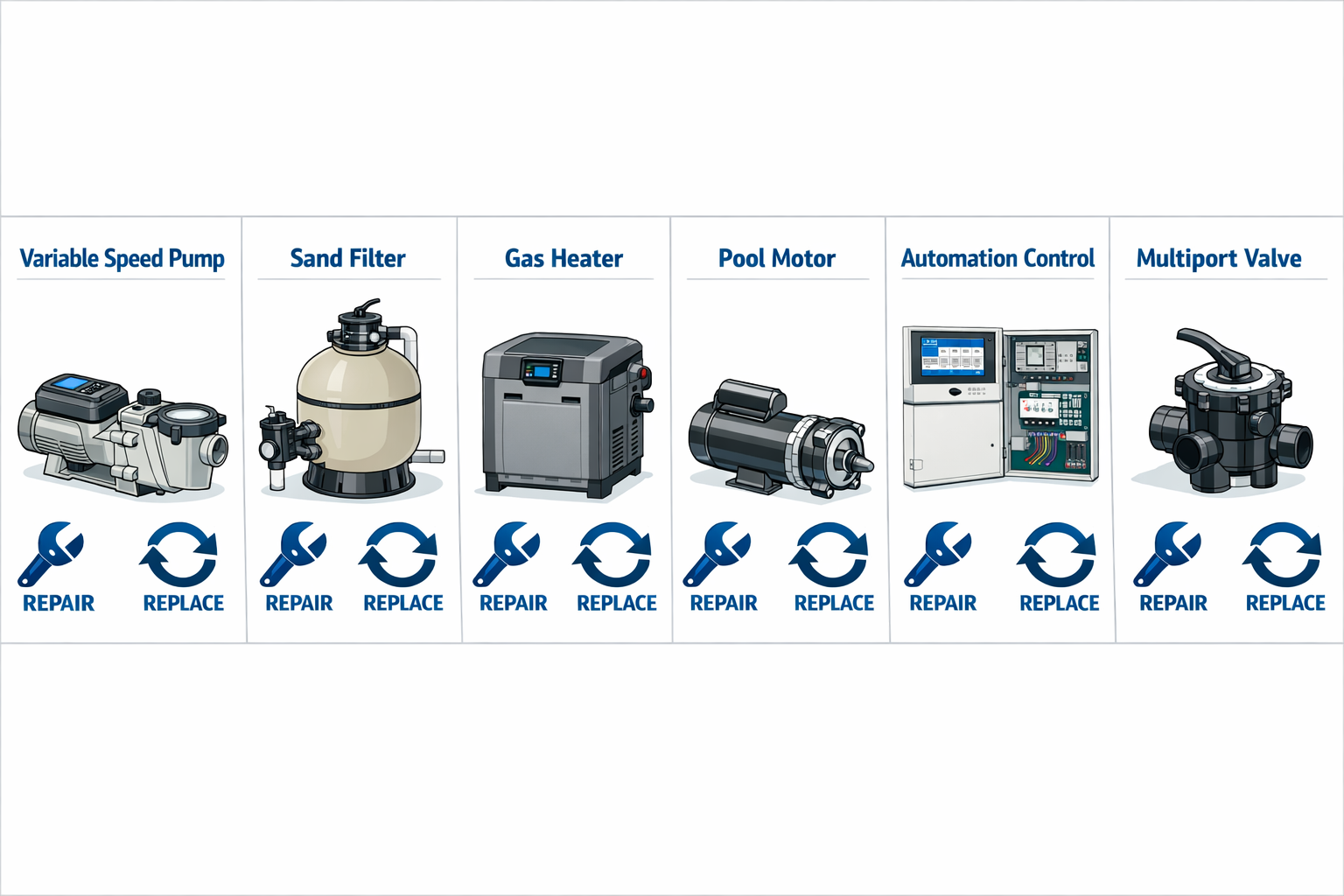
Corona pool equipment repair refers to the diagnosis, servicing, and replacement of the mechanical and electrical systems that keep a residential pool safe, clean, and comfortable. This includes pumps, filters, heaters, motors, automation controllers, timers, and valves.
For homeowners in Corona, CA, the combination of hard water (high mineral content), intense summer heat, and extended swimming seasons means equipment wears faster than in milder climates. A pool that runs 10 to 11 months per year needs more frequent service than one used only in summer.
The core systems covered:
| System | Primary Function | Typical Lifespan |
|---|---|---|
| Pump | Circulates water | 8–12 years |
| Motor | Powers the pump | 5–10 years |
| Filter (sand/cartridge/DE) | Removes debris and contaminants | 5–20 years (varies by type) |
| Heater (gas/heat pump) | Warms pool water | 8–15 years |
| Automation controller | Manages all systems remotely | 10–15 years |
| Timer | Controls pump run schedules | 5–10 years |
| Valves (check/diverter) | Direct water flow | 7–15 years |
Pumps and Motors: Repair or Replace?
The motor is usually the first thing to fail in a pump assembly — and replacing just the motor is almost always cheaper than buying a whole new pump.
Signs a pump or motor needs attention:
- Loud grinding, screeching, or humming
- Pump loses prime repeatedly
- Visible water leaking from the shaft seal
- Breaker trips when the pump starts
- Reduced water flow despite clean filter
Repair vs. replace decision:
- Repair if the pump housing is intact and the unit is under 7 years old. Motor replacements typically run $150–$400 in parts.
- Replace if the pump is over 10 years old, the housing is cracked, or repair costs exceed half the price of a new variable-speed unit.
💡 Pro tip: Upgrading to a variable-speed pump during replacement can reduce energy consumption significantly compared to single-speed models — a relevant consideration given California’s electricity rates.
How to Know When Your Pool Filter Needs Service
Pool filter repair depends entirely on filter type. Sand filters, cartridge filters, and diatomaceous earth (DE) filters each fail differently.
Sand filters: Channeling (water bypasses the sand bed), cloudy water despite normal chemistry, or a cracked lateral inside the tank all signal service needs. Sand media should be replaced every 5–7 years.
Cartridge filters: Torn or collapsed pleats, persistent cloudy water after cleaning, and cracked end caps mean the cartridge needs replacement (not the whole filter). Cartridges typically last 1–3 years depending on bather load.
DE filters: Torn grids or a broken manifold cause DE powder to blow back into the pool. Grid replacement is a repair; a cracked tank body usually means full replacement.
Local service providers such as Reign Pool Services handle pool filter repair in Corona and surrounding areas, including grid replacement and multiport valve rebuilds. [3]
Heater Repair vs. Replacement: What Corona Homeowners Should Know
Gas and heat pump pool heaters are the most expensive single piece of pool equipment, so the repair-vs-replace decision carries real financial weight.
Repair makes sense when:
- The unit is under 8 years old
- The issue is a failed igniter, thermostat, or pressure switch (all relatively low-cost parts)
- The heat exchanger shows no corrosion or scaling damage
Replace when:
- The heat exchanger is cracked or heavily scaled (common in Corona’s hard water environment)
- The unit is over 12 years old and parts are discontinued
- Repair quotes exceed 60% of a new unit’s cost
Corona’s water hardness accelerates scale deposits inside heater heat exchangers. Annual descaling and proper water balance (pH 7.4–7.6, calcium hardness 200–400 ppm) extend heater life considerably.
Automation, Timers, and Valves: The Overlooked Systems
Automation systems, timers, and valves are low-profile but high-impact — a failed timer can run your pump 24/7 and spike your electric bill before you notice.
Timers: Mechanical timers fail when trippers break or the motor burns out. Digital timers lose programming after power outages if the backup battery is dead. Replacement timers are inexpensive ($30–$150) and a straightforward DIY repair for handy homeowners.
Automation controllers: Systems from brands like Pentair and Hayward allow remote control of pumps, heaters, lights, and valves via smartphone. When a controller malfunctions, check for firmware updates before assuming hardware failure. Board replacements run $200–$600.
Valves (check valves and diverter valves): A failed check valve allows water to flow backward, which can damage the pump. Diverter valves that stick or crack cause circulation problems. Both are relatively inexpensive to replace ($20–$80 in parts) but require draining the affected plumbing line.
Finding Reliable Corona Pool Equipment Repair Services
For Corona homeowners, choosing a licensed, insured pool service contractor protects against liability and ensures repairs meet California code.
ORCA Pools is a recognized pool service provider in Corona, CA, listed on the Pool and Spa News Top 50 Service list and verified as a Google-backed trusted business. [1] For parts and supplies, PEP Pool Supply Corona has operated since 1992 at 2855 Ragle Way, Corona, CA 92879, serving as one of six commercial pool supply stores in Riverside County. Their hours are Monday through Friday, 6:00 AM to 4:00 PM. [2]
What to look for in a service provider:
- California C-53 Swimming Pool Contractor license
- Liability insurance and workers’ compensation
- Written estimates before work begins
- Warranty on parts and labor (minimum 90 days)
- Verifiable local reviews
FAQ: Corona Pool Equipment Repair
Q: How often should pool equipment be inspected?
A full equipment inspection should happen at least once per year, ideally at the start of swim season. High-use pools benefit from a mid-season check as well.
Q: Can I repair pool equipment myself?
Minor tasks like replacing a timer, cleaning a cartridge filter, or swapping a pressure gauge are reasonable DIY projects. Electrical work on motors or heaters should be handled by a licensed technician.
Q: How long does a pool pump last in Corona, CA?
With proper maintenance, a quality pump lasts 8–12 years. Hard water and year-round use in Corona can push that toward the lower end without regular service.
Q: What causes a pool pump to lose prime?
Common causes include a clogged basket, air leak in the suction line, low water level, or a worn shaft seal. Check the basket and water level first before calling for service.
Q: Is it worth repairing an old pool heater?
If the heater is over 10 years old and the repair involves the heat exchanger or major components, replacement is usually the better investment, especially given newer units’ improved efficiency.
Q: What is a multiport valve and when does it need replacement?
A multiport valve on a sand or DE filter controls flow direction (filter, backwash, waste, recirculate). It needs service when it leaks internally, bypasses water to waste, or the handle becomes stiff. Rebuild kits are available; full replacement is needed if the body cracks.
Q: How does Corona’s hard water affect pool equipment?
Hard water causes calcium scale to build up inside heaters, filter tanks, and pipe fittings. This reduces efficiency and can cause premature failure. Regular water balancing and annual descaling treatments mitigate the damage.
Q: What permits are required for pool equipment replacement in Corona?
Certain electrical upgrades and gas line work require permits through the City of Corona. Check with the city’s environmental and public works department for current residential requirements. [4]
Conclusion: Actionable Next Steps for Corona Pool Owners
Pool equipment doesn’t fail overnight — it degrades gradually, and catching problems early is always cheaper than emergency repairs. Here’s what to do now:
- Schedule an annual equipment inspection with a licensed Corona pool service contractor before peak swim season.
- Know your equipment ages. Write down the installation year for your pump, heater, and filter. Anything over 8–10 years old should be on your replacement radar.
- Test your water weekly and keep pH, calcium hardness, and total alkalinity in range to slow scale buildup on heaters and filters.
- Check your timer and valves at the start of each season — these small components cause outsized problems when they fail unnoticed.
- Get written quotes for any repair over $200 and apply the 50% rule: if repair costs exceed half the replacement price, buy new.
- Source parts locally when possible. PEP Pool Supply Corona has served Riverside County since 1992 and stocks common repair parts. [2]
Staying proactive with corona pool equipment repair keeps your pool safe, your energy bills manageable, and your equipment lasting as long as possible.
References
[1] Pool Service Corona – https://orcapoolsandspas.com/pool-service-corona/
[2] Corona Ca – https://poolelectrical.com/location/corona-ca/
[3] Pool Filter Repair – https://reignpoolservices.com/pool-repairs/pool-filter-repair/
[4] Residential – https://www.coronaca.gov/departments/public-works/environmental-services/residential